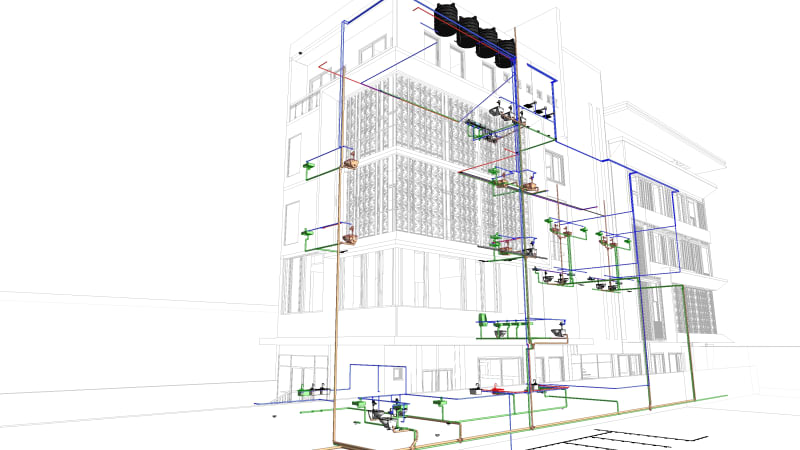
BIM has moved well past the question of whether to adopt it. In 2026, the active discussions in AEC practices are about which BIM capabilities to prioritise, how to structure data for downstream use, and how to work with clients who now expect BIM as a baseline deliverable. Here are six trends that are reshaping how BIM is specified, delivered and used this year.
1. ISO 19650 becomes the default contractual framework
ISO 19650 adoption has accelerated beyond the UK market where it originated. Government and infrastructure clients in Australia, the UAE, Singapore and mainland Europe are now requiring ISO 19650-aligned BIM Execution Plans on major projects. For AEC teams, this means establishing consistent naming conventions, CDE (Common Data Environment) workflows and information delivery milestones as standard practice rather than project-by-project custom agreements. Practices that have not formalised their BIM processes are finding this increasingly costly to retrofit.
2. Cloud-based collaborative modeling replaces file-sharing
The shift from shared server folders to cloud-based environments like Autodesk Construction Cloud, BIM 360 and Trimble Connect is now near-complete on large projects. Real-time model access, issue tracking and document management in a single environment has eliminated the version-conflict problems that plagued federated model workflows. The next frontier is multi-company cloud collaboration: owner, architect, structural engineer and MEP consultant all working in the same live model environment rather than exchanging reference files.
3. AI-assisted modeling accelerates routine tasks
Generative AI tools applied to BIM are moving from experiment to production use in 2026. The mature applications are in space layout generation, automated clash detection rule-setting, quantity extraction from models, and drawing sheet population from model data. The less mature but more discussed application — AI generating building geometry from natural language descriptions — is a real capability in constrained contexts, but it remains far from replacing modeller judgment on complex projects. The near-term AI value in BIM is in eliminating repetitive tasks within a human-directed workflow.
4. Digital twin integration connects design models to operations
The LOD 500 as-built Revit model being handed over to a facilities management team was the original promise of BIM-to-operations. In 2026, the practical implementation of that promise is through digital twin platforms that connect the as-built model to live sensor data, maintenance records and energy monitoring. Building owners who invested in model quality during construction are extracting operational value through reduced energy costs, predictive maintenance and faster response to building systems failures.
5. OpenBIM and IFC gain traction over proprietary formats
IFC (Industry Foundation Classes) has long been the theoretical answer to interoperability between BIM platforms. In 2026, IFC 4.3 is in active use on infrastructure and civil projects, and the pressure to deliver IFC-native — rather than IFC-exported — models is increasing. For practices using Revit, ArchiCAD and Tekla simultaneously on complex projects, the shift toward OpenBIM workflows is eliminating the geometry loss and data degradation that made earlier IFC exports unreliable.
6. Scan to BIM becomes standard for renovation work
The cost of terrestrial laser scanning has fallen to the point where it is now specified on renovation and fit-out projects below the threshold where it would previously have been considered. Accurate as-built conditions captured from point clouds, processed into LOD 300–350 Revit models, are replacing measured surveys for existing buildings. The reduction in coordination errors on renovation projects — caused by as-built drawings that did not reflect actual conditions — is the primary driver of this shift.
What this means for practices in 2026
The common thread across these trends is that BIM is becoming more data-driven, more connected and more contractually defined. Practices that have invested in standardised processes, trained staff and a clear data management strategy are well positioned to meet these demands. Those still managing BIM on a project-by-project basis without consistent standards will find the gap between client expectations and delivery capability widening over the next two years.
Need BIM expertise that keeps pace with 2026 standards?
The Zenith Visions delivers ISO 19650-aligned BIM models and cloud-compatible deliverables for AEC teams worldwide.
Explore BIM Services