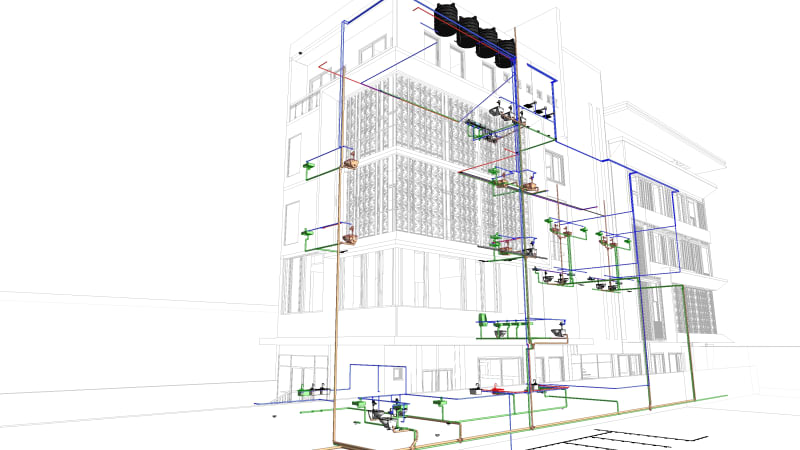
It is tempting to see clash detection as an extra cost, a line item that could be trimmed. The honest way to judge it is against its alternative: discovering, mid-installation, that a main duct runs straight through a primary beam, or that the drainage and the cable tray were both designed to occupy the same void. One of those is a model review; the other is demolition, delay, and a dispute about who pays.
This article breaks down where MEP clashes actually come from, what they cost when they reach the site, and why detection is one of the highest-return activities on a project.
Where MEP clashes come from
MEP clashes are not carelessness; they are structural to how buildings are designed. Services are dense, the ceiling void is shallow, and the disciplines are designed by separate teams, often separate companies, who do not see each other's models in real time. A duct, a pipe and a tray each get drawn to fit, in isolation, and nobody notices they all claim the same space until they are being installed.
The two kinds of clash that matter
Coordination distinguishes between clash types because they cost differently:
- Hard clashes: two elements physically occupy the same space, a duct through a beam. These must be resolved.
- Soft clashes: elements violate a required clearance, a valve with no access space. These must be judged against tolerance.
- Workflow clashes: elements conflict in time or sequence, two trades needing the same zone at once.
What a clash costs on site
The cost of a clash scales brutally with how late it is found. In the model, it is minutes of a coordinator's time. On site, it triggers a chain reaction:
- Site rework: tearing out and reinstalling completed services
- RFIs and design queries that stall the affected trades
- Program delay as trades wait on each other
- Variation claims and the disputes that follow
A worked example: the ceiling that did not fit
On an uncoordinated office fit-out, the M&E contractor installs the primary ductwork to the 2D drawings. The sprinkler subcontractor follows and finds the mains have nowhere to go, the duct is exactly where the main was meant to run. Two zones are torn out and reworked, two weeks are lost, and a five-figure variation lands on the client. Nothing was designed badly; the conflict was simply never looked for.
Run the same project through clash detection and that exact conflict surfaces in a coordination review weeks before fabrication. It is rerouted in the model for the cost of a meeting. The design outcome is identical; only the cost and the timing changed.
The economics, plainly
Clash detection costs a handful of coordination cycles, predictable, modest and front-loaded. Its alternative costs rework, delay and dispute, unpredictable, large and back-loaded onto the most expensive phase of the project. Leading firms quantify this: they track clashes resolved and translate them into RFIs and variations avoided, which is how BIM coordination consistently demonstrates a strong return.
The takeaway
MEP clash detection does not add risk to a project; it removes it, and it moves the cost of solving conflicts from the site to the model. The few coordination cycles it takes are repaid many times over by a build that runs to program with services that fit the first time.
Need MEP BIM you can build from?
The Zenith Visions delivers accurate, coordinated MEP BIM for AEC teams worldwide. Tell us about your project and we’ll respond within one business day.
Explore MEP BIM